

How luxury property can combine financial potential, personal use, and long-term family value.
A luxury second home works differently from a portfolio holding. It combines a tangible appreciating asset with direct owner control and potential rental income during periods when the home stands unused, with tax treatment distinct from financial instruments and personal and family use that no equity position can offer. For the right buyer, ownership delivers both financial return and lived value together.

Why Discerning Buyers are Opting for a Second Home over other Assets
For a buyer with capital already invested across equities, mutual funds, and fixed income. A second home occupies a different category. It is an asset that gets used as well as held. A stock certificate cannot help you host a celebratory dinner or a family gathering. A mutual fund cannot be renovated, repositioned, or handed down with a story attached. There is no argument that luxury property should replace financial assets.
It is an argument that ownership answers a question financial assets cannot: what is this money doing for my family and loved ones while it appreciates?
More Indian buyers are now asking that question; money that once sat entirely in listed instruments is now finding its way into second properties, chosen for use as much as for return. The article aims to understand what ownership exactly delivers set against its counterparts.
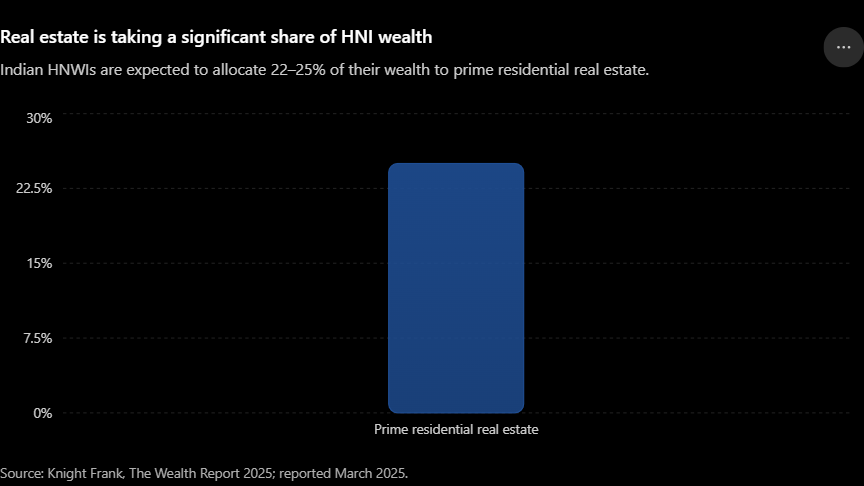
Source: Knight Frank, The Wealth Report 2025
How Does a Luxury Second Home Compare to other Investments?
Luxury real estate does not compete with equities, gold, or REITs on the same terms. Each asset behaves differently, and those differences matter more than any single return figure.
| Factor | Luxury Property | Equities | Gold | Commercial Property / REITs |
| Control | Owner can renovate, reposition or change use | None | None | Limited, shared with other investors |
| Volatility | Low daily volatility, not priced continuously | High, priced every trading day | Moderate, sentiment-driven | Low to moderate |
| Liquidity | Low, slow to exit and thinly traded | High | High | Moderate |
| Entry cost | High, concentrated in one asset | Low, easily diversified | Low | Moderate to high |
| Leverage | Available through home loans | Limited | Limited | Available, more complex |
| Utility | Usable by the owner | None | None | None, unless owner-occupied |
Control here is the standout advantage a second home holds over every other asset listed. An owner can improve a property, change how it is used, or reposition it entirely, a decision no shareholder or gold holder can make. Liquidity works the other way; luxury property is slow to sell and thinly traded, pretending otherwise would undermine the rest of the comparison. A serious buyer already knows this; naming it plainly is what makes the rest of the case credible.
Here the honest conclusion is not that property outperforms equities; it is that property offers a different set of characteristics, suited to a different objective: capital that can be used, not only held.
What Returns Can I Expect from a Luxury Home?
Returns from a luxury second home come from two different sources, and buyers do well to treat them separately. Capital appreciation in non-urban luxury markets is driven less by broad market sentiment and more by specific local factors: land scarcity in established markets, the timing of infrastructure such as roads and airports, constrained new supply, and how mature a location has become as a second-home location. Appreciation in these markets is uneven; a well-located home in a maturing destination can outperform a similar-sized home a few kilometres away in a less established one. Buyers should treat appreciation as location-dependent and not a market-wide guarantee.
Rental income is the second most important factor; it deserves a grounded description rather than an aspirational one. Well-designed luxury villas are let for family holidays, small weddings, and extended stays, especially during the peak season. Demand drops sharply outside these windows. A home that is turnkey and professionally managed commands materially higher occupancy rates than one left to informal arrangements. The difference between a home that earns occasionally and one that earns reliably within its season.
For how rental income is taxed, see Top Tax Benefits of Owning Property. For what it costs to keep a home rental-ready, see Maintenance and Upkeep.
Source: Liases Foras, North Goa Real Estate: The Driving Forces, 2026
Purchasing vs Renting a Holiday Home
This is the comparison most second-home buyers are actually making, whether or not they say so directly. The break-even question is straightforward to frame, if not to answer precisely:
- How many weeks a year does a family realistically spend at a holiday destination before ownership costs less, in money and in certainty, than repeatedly renting the same standard of home?
For families with a strong yearly rhythm: the same weeks, the same destination, ownership starts to make sense well before renting would suggest. Ownership also buys certainty renting cannot. A rented villa may not be available during the exact week a family wants it, especially during peak season. An owned home is available on the family’s terms, set up the way they want it and left as it is between visits.
Set against this: capital stays locked in a single asset, upkeep is an ongoing obligation whether or not the home is used, and the family is committed to one location. And for a family still deciding where to spend their time each year, or for buyers who value flexibility over a fixed address, renting remains the better option. Ownership suits a family that already knows where it wants to return.

A Luxury Home as a Family Asset
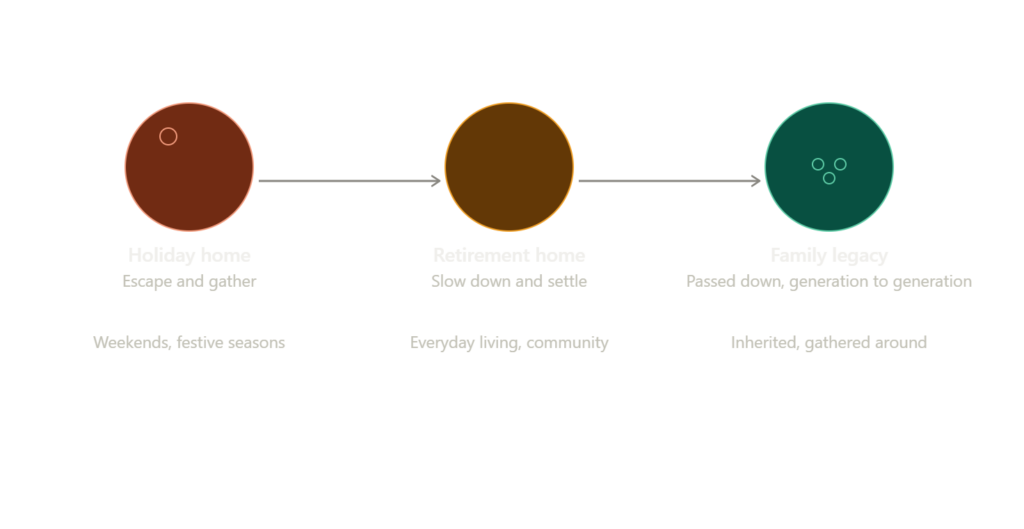
The financial case for ownership is only part of the argument; the other part is what a home does for a family across years. A second home becomes space for family time, a gathering point across generations, the home everyone assumes to be their destination for a holiday, wedding, or a simple gathering. A home used this way for a decade holds a different value than one bought and left empty.
Another factor here is Continuity: a home passed on to generations in a way a portfolio rarely does with the same clarity. Children and grandchildren inherit a place, not only a number on the statement. A home that carries memories in a way an account does not. A home bought as a holiday home today can also be looked at through multiple lenses: a retirement home, a primary residence, and more so as remote work loosens the tie between career and location. Regular time away from a metro also has a significant effect on one’s wellbeing, with family time increasingly weighing alongside financial return.
None of this should be overstated; a second home does not replace family time on its own. But it does make that time easier to have, more often than not, in a place that stays consistent while everything else in a family’s life changes.
Tax and Ownership Structure
Property ownership carries tax treatment that differs meaningfully from financial assets. Owners can claim deductions on home loan interest and principal repayment, and access capital gains reliefs when the money is reinvested in another property. Now NRIs have specific provisions that apply to property purchase, holding and sale. However, none of these provisions make ownership free of tax; they make its tax treatment materially different from holding the same capital in equities or fixed systems. Different enough that most buyers should have this conversation with an advisor before and not after the purchase.
For the specific sections, limits, and exemptions that apply, see Top Tax Benefits of Owning Luxury Real Estate.

What does Ownership Actually Mean
A second home carries ongoing running costs and upkeep: staffing, utilities, monsoon-proofing, and general maintenance regardless of the family visits that year. Left unmanaged, these costs and coordination are now a job in itself. Rental income, where it exists, is seasonal rather than steady and cannot be expected to cover ownership costs on its own. Capital stays tied in a single, illiquid, single-location asset, and exiting that position takes time when the moment comes.
None of this is a reason to avoid ownership; it is a reason to structure it properly from the get-go. Most of these demands become manageable with the right property management and support in place. This is precisely what separates a second home that becomes a burden from one that stays a pleasure to own. See Maintenance and Upkeep for what this costs in practice, and Trust and Confidence for how Isprava structures this after handover.
Is a Luxury Second Home Right for You?
A second home makes sense for buyers with a long holding horizon, genuine and repeated intended use, capital that does not need to stay liquid, and a comfort with holding a concentrated, single-location position. It suits families who already know where they want to spend their time, year after year.
It makes less sense for buyers chasing short-term returns, anyone who may need that capital back on short notice, or anyone expecting rental income to offset ownership costs substantially. It also does not suit a family still deciding between multiple destinations, since ownership works best once that decision has already been made.
The clearest sign that ownership is right: the destination is already chosen, and only the home remains to be decided.
The Case for Ownership
A luxury second home is not simply a financial position. It is an asset built for use, designed to hold its value while a family actually lives in it. Isprava homes are built with both in mind — long-term value and everyday liveability — with management handled after handover, so ownership stays a pleasure rather than a task. Explore the Isprava homes collection, or read more on Trust and Confidence to understand how this works in practice.
Frequently Asked Questions
- Is buying a luxury second home a good investment in India?
It depends on the objective. A luxury second home offers control, potential rental income, and family use that financial assets do not, though it should be weighed against its lower liquidity and concentrated exposure to one location.
- Can I earn rental income from a luxury villa?
Yes, particularly around peak season and for events, weddings, and extended family stays. Income is seasonal rather than steady, and turnkey, professionally managed homes typically command higher occupancy and rates.
- How much does a luxury villa appreciate?
Appreciation varies by location and is driven by land scarcity, infrastructure timing, and how established the destination has become. It is uneven across micro-markets rather than a fixed, predictable rate.
- Is it better to buy or rent a holiday home?
This depends on how many weeks a year a family visits the same destination. Frequent, repeated use favours ownership; occasional or varied travel usually favours renting.
- What are the disadvantages of owning a second home?
Ongoing upkeep costs, seasonal rather than steady rental income, capital locked in a single illiquid asset, and a slower exit when it’s time to sell.
- Can I use my second home as a retirement home later?
Yes. Many buyers purchase a second home with the option to convert it into a retirement home or primary residence later, particularly as remote work reduces the need to live near an office.
- How liquid is a luxury property if I need to sell?
Less liquid than equities or gold. Luxury property is thinly traded and typically takes longer to sell, which is why it suits buyers who do not need quick access to that capital.
- Do I need to manage the property myself?
No. Professional property management handles staffing, maintenance, and rental coordination, keeping ownership from becoming a second job for the owner.
- Is a second home better than investing in equities?
Neither is inherently better; they serve different purposes. Equities offer liquidity and diversification, while a second home offers usable value, control, and family continuity that equities cannot.
- Can NRIs earn rental income from property in India?
Yes, subject to specific tax provisions for non-resident owners. See Top Tax Benefits of Owning Luxury Real Estate for details on how this income is taxed.