

A practical guide to assessing the developer, project, location, and deal
Buying a luxury home is rarely just about whether you like the home. At the higher end of the market, the more important questions are less visible.
- Who is developing it?
- What exactly are you buying into?
- What has been approved?
- How has the developer delivered in the past?
- What will it cost to own the property?
- If sold later, how easy will it be?
Luxury real estate can be harder to evaluate than mainstream property because comparable transactions are fewer, pricing is less transparent, and real estate markets can be less so. A property can look exceptional and still need a closer look and inspection. A thorough evaluation should cover the developer’s completed track record and delivery timelines, RERA registration and project documentation, title, cost of ownership, and the property’s potential liquidity. The aim here is not to eliminate the risk but to understand what you are buying before you commit.
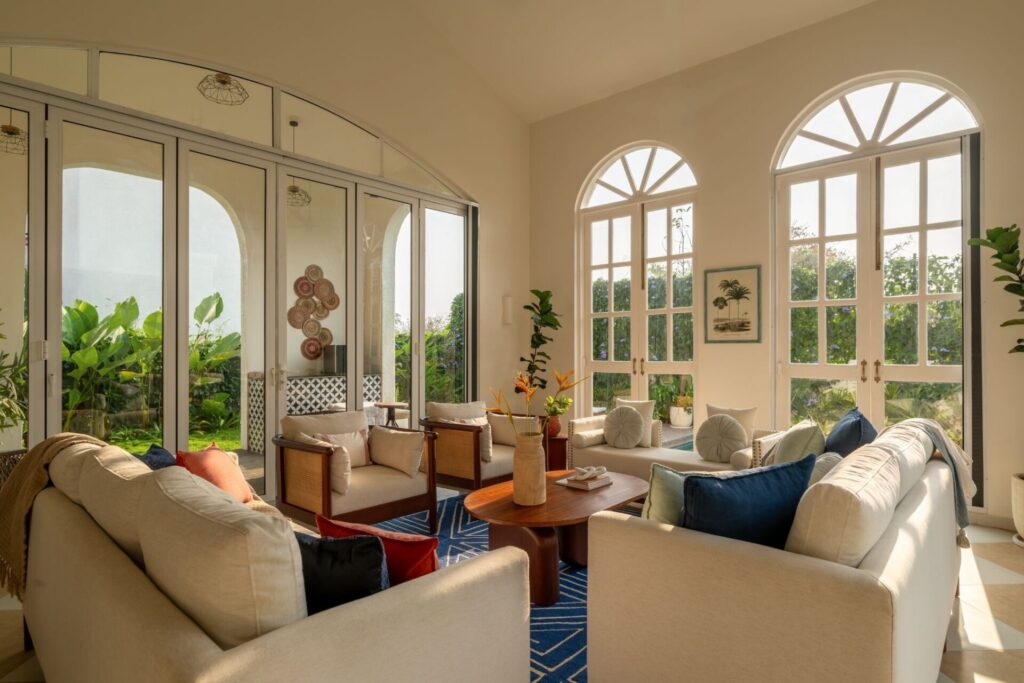
Why Luxury Homes Need A Different Approach
Luxury real estate does not always have the same set of benchmarks available in the mainstream housing market. There may be fewer comparable properties and transactions and less publicly available resale data. This makes it difficult to determine if the quoted rate is the fair value simply by comparing it with neighbour properties and land rates.
The way a luxury property is presented can also make an evaluation more difficult. Design, architecture, landscape, amenities and interiors all influence the perceived value of a home, but they should not substitute for due diligence. A proper evaluation of the property, land, and the developer before the sales experience.
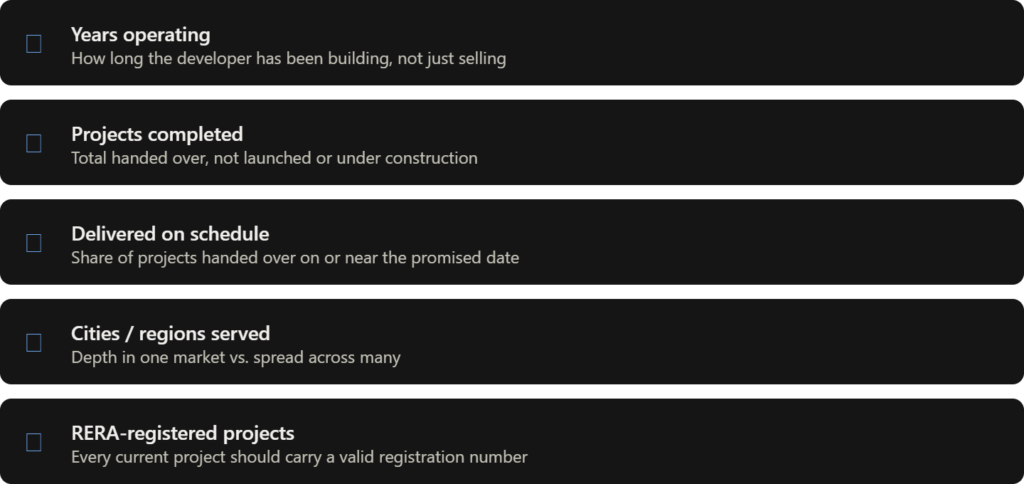
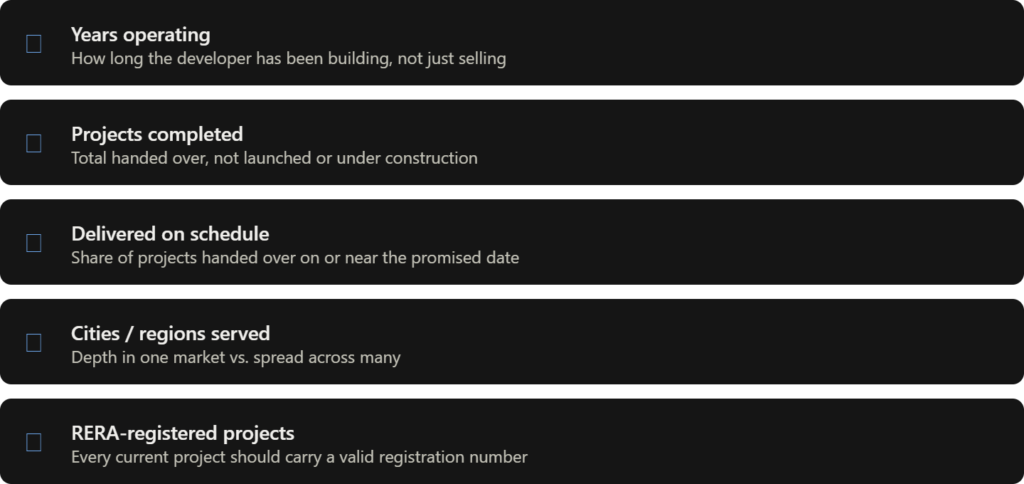
Before committing to a luxury property, assess four points separately:
The Developer: Can they demonstrate a consistent record of completing and delivering the projects?
The Project: Are the land, approvals, specifications, pricing, and payment terms clearly stated and documented at every step of the project?
The Investment: Does the property make sense for you and your needs, the expected costs, and the eventual exit?
Asking these questions helps make it easier to identify the gaps. A strong developer does not automatically make every project a good purchase, just as an attractive property does not compensate for unclear documentation.
How Can One Evaluate a Luxury Property Developer?
The developer is one of the most important parts of the purchasing process because the quality of the home depends not only on the final promised product, but on the developer’s ability to deliver it. Start by checking and questioning with completed projects, rather than relying on renderings, show homes, or proposed developments. Ask how many projects the developer has completed, the time taken from start to finish, how long the developer has been around, and if you could physically visit a completed site and home. Seeing an older project/ completed home reveals more about the construction quality, aging, maintenance, and the after-sales support than a newly finished show home.
The next job is to examine the delivery record and ask the relevant questions:
- When were the previous projects originally scheduled for completion?
- When were they actually completed?
- Were the completion dates revised or changed?
- Were the homeowners informed about the delays?
- Can existing owners be contacted independently?
RERA records can provide important information, including registration details and information relating to completion dates and complaints. One should also verify the developer’s RERA registration for the project. The relevant state RERA portal can provide information about the promoter, project details, registered timelines, and complaints where applicable. One cannot solely rely on the sales representative’s pitch and take on the project.
Look at the developer’s corporate structure and standing as well. Understand which entity is actually responsible for the project and if there are further corporate or institutional relationships attached to the project. The understanding of which entity is actually developing the project is important, as is who owns or controls the entity and which entity would be responsible for your purchase.
It is also crucial to investigate the litigation history, search public court records and relevant databases for material disputes involving the developer or the project entity. A dispute does not automatically make a developer unsuitable, but understanding its nature and status is part of an informed opinion.
And at the end, the most pressing questions on the developer’s business model should be addressed.
- Does the developer build and hold projects over time?
- Is the business structured around launching and exiting individual projects?
There is no right or wrong model, but understanding the process can help you assess the developer’s long-term involvement with the property. The questions to ask are straightforward:
- How many projects have you completed?
- Can I visit one that was delivered several years ago?
- What was the committed delivery date, and when was the project actually completed?
- Where can I independently verify the project’s RERA information?
- Which legal entity is developing this project?
- Can I review the relevant title and approval diligence?
The more directly these questions can be answered with documentation, the easier it is to assess the developer objectively.
What Should One Check About The Project Itself?
Once the developer has been assessed, evaluate the specific project independently. A reputable developer does not remove the need to conduct project – level diligence.
Start with the land: Understand who owns the land and what checks have been done to establish clear ownership. Who conducted the title search, and whether the buyer can review the relevant documents and report. One also has to understand the land classification and zoning applicable to the property and home. The permitted use of land can affect what can legally be built on it.
Separate approvals from applications: Check for a list of approvals required for the project and identify which have been obtained and which have only been applied for and are yet to be approved. These are not interchangeable; an application for approval does not guarantee an approval. Any material representation about permissions, zoning or development potential should be supported by documentation.
Understand what area you are paying for: Check whether the quoted area refers to carpet area, built-up area, or super built-up area. These measurements describe different things and can make two similar properties difficult to compare. Check for the exact area calculation and make sure the price is being compared on a like-for-like basis.
Establish the Actual price: The headline price may not represent the entire amount payable. Ask what is included and what is charged separately, including:
- Infrastructure charges
- Parking
- Club or amenity charges
- Statutory charges
- Registration and stamp duty
- Furnishing or fit-out costs, where applicable
The payment schedule also includes due scrutiny, understanding what portion of the payment is linked to identifiable construction milestones and what is payable independent of the progress.
Review the Specification Sheet
A detailed specification is more useful than broad descriptions such as ‘’premium fittings’’ or ‘’high-quality materials.’’ Checking the exact brands, finishes, materials used, and equipment; keeping all of this generic makes it harder to establish what will actually be delivered. And mainly understanding who maintains shared infrastructure and amenities and what the services cost.
How Accessible is the Location?
A luxury property should be evaluated against the future of its micro-market, not just its surroundings. Start by separating the committed infrastructure from the announced infrastructure. A proposed road, airport, commercial development, or other infrastructure project may influence the future accessibility or demand. But an announcement is not the same as funded and committed infrastructure. Ask what stage the relevant project has reached and where the project can be independently verified.
Then look at existing and upcoming supply:
- How many comparable properties are already available nearby?
- How many are under development?
A location with substantial new supply may behave differently in resale and rental markets from one with limited competing inventory. Accessibility matters too. Consider the actual travel time from your primary city of residence and how reliable that journey is throughout the year. A destination that works for a weekend visit in one season may be less convenient during another.
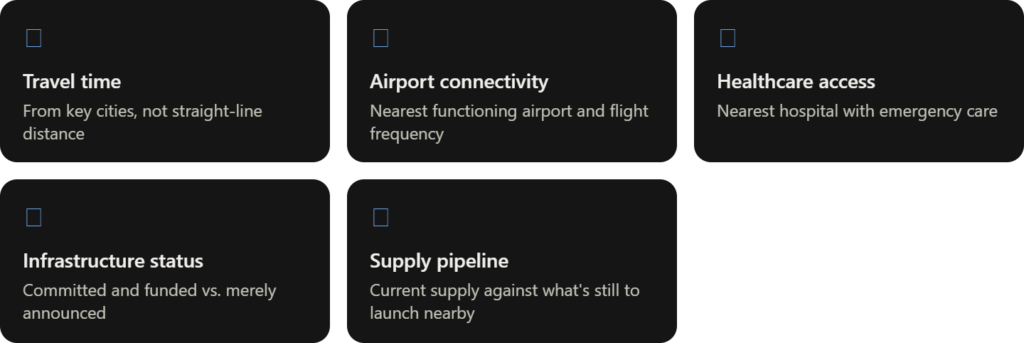
Also consider the property’s proximity to healthcare, schools, and airports, particularly if there is any possibility that the home could become a primary residence later.
If rental income matters, investigate actual rental demand rather than advertised yield. Ask how strong demand is outside peak periods, how many comparable properties compete for the same guests, and what occupancy looks like across the year.
Finally, look for evidence of an established resale market.
- How frequently do comparable properties transact?
- How long do properties typically remain on the market?
- What is the gap between asking prices and actual transaction prices?
Location should ultimately be assessed as a combination of accessibility, infrastructure, supply, demand, and resale evidence—not simply reputation or future potential.
How Does One Figure out Construction Quality?
A site visit should involve more than looking at the finished interiors. If possible, visit a completed home by the same developer, rather than relying exclusively on a show property. An occupied or several-years-old home can reveal how materials, finishes and building systems have performed over time.
Ask for the structural and material specifications and establish whether they are documented in the sale agreement or specification schedule.
In coastal and high-rainfall locations, pay particular attention to waterproofing and drainage. Look for evidence of water ingress, staining, dampness and drainage issues in completed properties.
Inspect the areas where shortcuts are often easiest to spot:
- Joints and edges
- Doors and windows
- Flooring transitions
- Joinery
- Bathroom fittings
- Hardware
- Paint and surface finishes
Do not overlook the less visible systems. Ask about electrical infrastructure, plumbing, water source, sewage management, and backup power.
You should also understand the warranty and defect liability arrangements:
- What is covered?
- For how long?
- Who is responsible for rectifying defects?
- Is there a defined process for raising and resolving issues?
Before handover, ask whether an independent inspection is permitted. An independent professional can identify construction or finishing issues that may not be obvious during a sales-led walkthrough.
The objective of a site visit is not simply to decide whether the home looks good. It is to determine whether the finished product supports what was specified and promised.
What is the Actual Cost of Owning a Luxury Home?
The purchase price is only one component of the cost of owning a luxury home. Begin by calculating the one-time costs associated with the purchase. Depending on the property and transaction, these can include stamp duty, registration, applicable taxes, furnishing, and other transaction or fit-out costs.
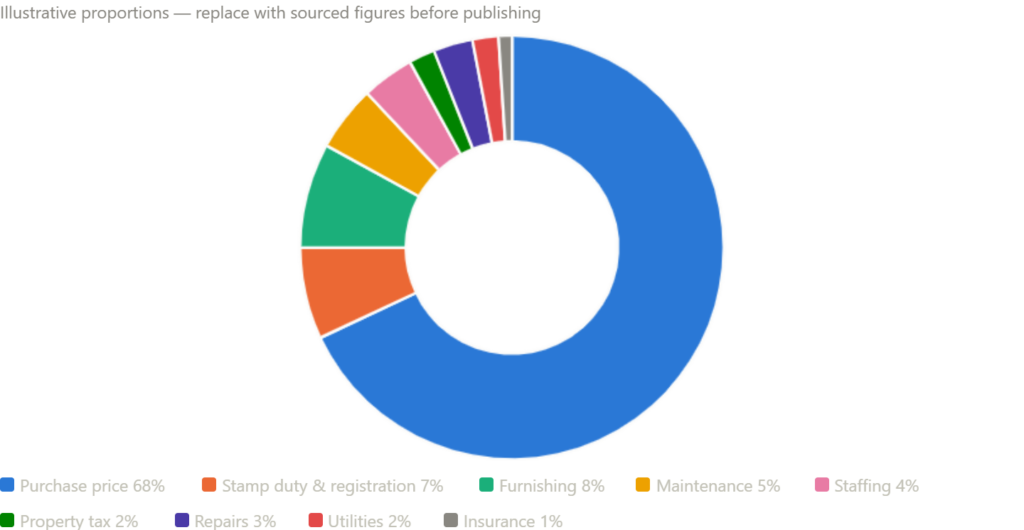
Then estimate the recurring costs:
- Property tax
- Maintenance and estate charges
- Staffing
- Utilities
- Insurance
- Repairs and replacement
- Landscaping and other property services
A second-home buyer should also account for the cost of keeping the property functional when it is unoccupied for extended periods. A large home, landscaped property or amenity-rich development may carry meaningful ongoing costs even when the owner is not using it.
If the property is intended to generate rental income, calculate these costs before estimating net yield. Gross rental revenue can give a very different picture from the amount remaining after management, maintenance, utilities, taxes and periods of vacancy.
Tax treatment can also affect the economics of ownership and should be assessed based on the buyer’s individual circumstances. For a broader overview, refer to the relevant guide to tax benefits.
What is the Evaluation of a Luxury Property?
The right property depends partly on what you expect the property to do for you.
Buy according to your objective
| Personal use | Rental yield | Appreciation |
| Design | Demand | Land value |
| Location | Accessibility | Infrastructure |
| Manageability | Management | Supply |
- Personal use: Prioritise design fit, location and manageability. A property that works beautifully for your family’s lifestyle may be more valuable to you than one with stronger rental potential. Consider how often you will realistically use it, how easy it is to reach, how much maintenance it requires, and whether the layout works for the way you spend time there.
- Rental yield: Prioritise demand, accessibility, management support and turnkey readiness. A property with attractive interiors is not automatically a strong rental asset. Demand, seasonality, operating costs and the ability to manage the home efficiently all matter.
- Appreciation: Focus more closely on land value, infrastructure timing and supply constraints. Examine what is already established, what infrastructure is genuinely progressing and how much competing inventory could enter the market.
A property selected primarily for personal enjoyment may not maximise rental income. A property selected for rental demand may not be the one you would most enjoy personally. And a property purchased for potential appreciation involves assumptions about future infrastructure, supply and demand. The most common mistake is to buy for one objective and expect the property to automatically deliver all three.

What Are the Factors to Look Out For?
Some warning signs are straightforward. Others appear minor individually but become significant when several occur together.
Look carefully if you encounter:
- An unregistered project, or RERA registration that does not correspond with what is being sold
- Reluctance to share title or approval documentation
- Generic specifications with no named brands, materials, or measurable standards
- A heavily front-loaded payment schedule that is not linked to construction progress
- No completed project available to visit
- Verbal assurances about approvals, zoning or infrastructure that cannot be supported with documents
- Pressure to commit quickly before you have completed legal, financial or technical diligence
- Guaranteed returns or rental yields, particularly where assumptions and supporting data are not clearly disclosed
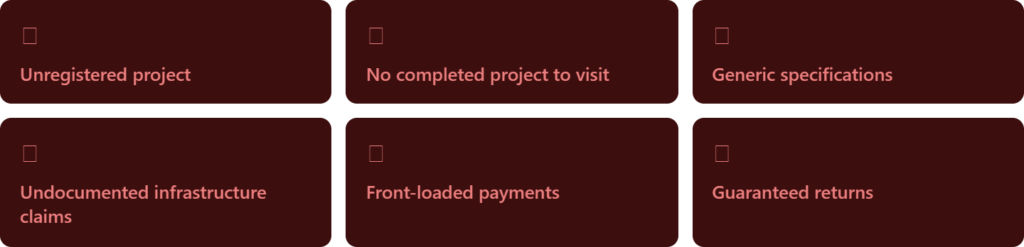
A single red flag does not necessarily mean you should walk away. It does mean you should ask more questions. The more important warning sign is a pattern: incomplete information, reluctance to provide documentation, inconsistent answers, and pressure to decide on independent verification.
In a significant property purchase, the ability to slow the process down and verify the facts is an advantage. Use it.
FAQ:
| Term | What to check |
| RERA registration | Valid, project-specific number |
| Carpet area | Actual usable space, not super built-up |
| Defect liability period | Duration the developer covers post-handover |
| Stamp duty | State-specific rate on transaction value |
| Registration | Separate charge from stamp duty |
| Maintenance charges | Ongoing, not one-time |
How do I check if a real estate developer is trustworthy?
Start with completed projects, delivery history, RERA records, corporate information, and publicly available litigation records. Speak to existing homeowners where possible and visit completed properties rather than relying only on the developer’s marketing material.
What documents should a developer share before I book a property?
The relevant documents depend on the project and jurisdiction, but buyers should understand the property’s title and land diligence, applicable approvals, RERA registration and project details, area calculations, specifications, payment schedule and contractual terms. A property lawyer should review the legal documentation before commitment.
Is RERA registration mandatory for villa projects?
Whether a particular project requires RERA registration depends on the applicable legislation, project characteristics, and exemptions. Buyers should verify the project’s status on the relevant state RERA authority rather than relying on a verbal representation.
What is the difference between carpet area and built-up area?
Carpet area generally refers to the usable floor area within the property’s internal walls, while built-up area includes additional areas such as wall thickness and certain other components. The exact definitions can depend on the applicable regulations, so buyers should check the stated measurement and its legal basis.
What should I check during a site visit?

Look beyond interiors. Check construction finishes, joints, doors and windows, waterproofing, drainage, plumbing, electrical systems, water supply and backup systems. If possible, visit an older completed property by the same developer to understand how the construction has performed over time.
How do I estimate the running cost of a luxury villa?
List all recurring expenses, including maintenance, estate charges, staffing, utilities, insurance, property tax, landscaping and repairs. If the property is rented, also include management costs, vacancy periods and expenses associated with preparing the property for guests.
What is a defect liability period?
A defect liability period establishes the period during which specified construction defects are the responsibility of the developer or relevant party, subject to the terms of the applicable agreement and law. Buyers should understand what defects are covered, the duration, and the process for raising a claim.
Should I buy an under-construction or completed luxury home?
A completed property allows you to inspect the actual home, construction quality, and surrounding environment before buying. An under-construction property may offer different pricing or configuration options, but it requires greater assessment of delivery timelines, construction progress, and execution risk.
How liquid is luxury real estate if I want to sell?
Luxury real estate can have a smaller pool of buyers and fewer comparable transactions than mainstream housing. Assess the property’s location, demand, competing supply, and evidence of actual resale transactions before assuming that an exit will be quick.
What questions should I ask a developer before buying?
Ask about completed projects, delivery timelines, RERA registration, title and approvals, exact area, specifications, payment milestones, recurring costs, maintenance responsibilities, warranties and handover. Most importantly, ask where each important claim can be independently verified.

A Considered Approach to Buying Luxury Real Estate
The strongest luxury property purchase is not necessarily the one with the most impressive presentation. It is the one that continues to make sense when the presentation is stripped away, and the underlying facts are examined.
Evaluate the developer. Verify the project. Understand the location. Inspect the construction. Calculate the full cost of ownership. Then test the property against your actual objective.
At Isprava, these are the same questions we believe buyers should be able to ask of any luxury developer. To understand how we approach trust, transparency, and confidence across our projects, explore Trust & Confidence.